blur_ratio() measures blur ratio of sounds referenced in an extended
selection table, as described by Dabelsteen et al. (1993). Low values
indicate low degradation of sounds.
Arguments
- X
The output of
set_reference_sounds(), an object of classdata.frame,selection_table, orextended_selection_table(the last 2 classes are created bywarbleR::selection_table()from the warbleR package) with the test sound files' annotations. Must contain the following columns: 1)sound.files: name of the.wavfiles, 2)selec: unique selection identifier (within a sound file), 3)start: start time and 4)end: end time of selections, 5)bottom.freq: low frequency for bandpass, 6)top.freq: high frequency for bandpass, 7)sound.id: ID of sounds used to identify counterparts across distances, and 8)reference: identity of sounds to be used as reference for each test sound (row). Seeset_reference_sounds()for more details on the structure ofX.- cores
Numeric vector of length 1. Controls whether parallel computing is applied by specifying the number of cores to be used. Default
1(i.e. no parallel computing). Can be set globally for the current R session via the"mc.cores"option (seeoptions()).- pb
Logical argument to control if progress bar is shown. Default
TRUE. Can be set globally for the current R session via the"pb"option (seeoptions()).- env.smooth
Numeric vector of length 1 determining the length of the sliding window (in amplitude samples) used for a sum smooth for amplitude envelope calculation (used internally by
seewave::env()). Default200. Can be set globally for the current R session via the"env.smooth"option (seeoptions()).- envelopes
Logical to control if envelopes are returned (as attributes,
attributes(X)$envelopes). DefaultFALSE.- hop.size
Numeric vector of length 1 specifying the time window duration (in ms). Default
11.6ms, which is equivalent to 512wlfor a 44.1 kHz sampling rate. Ignored ifwlis supplied. Can be set globally for the current R session via the"hop.size"option (seeoptions()).- wl
A vector with a single even integer number specifying the window length of the spectrogram. Default
NULL. If supplied,hop.sizeis ignored. Odd integers will be rounded up to the nearest even number. Can be set globally for the current R session via the"wl"option (seeoptions()).- ovlp
Numeric vector of length 1 specifying the percentage of overlap between two consecutive windows, as in
seewave::spectro(). Default70. Used for applying bandpass filtering. Can be set globally for the current R session via the"ovlp"option (seeoptions()).- n.samples
Numeric vector of length 1 specifying the number of amplitude samples to use for representing amplitude envelopes. Default
100. IfNULLthe raw amplitude envelope is used (note that this can result in high RAM memory usage for large data sets). Amplitude envelope values are interpolated usingstats::approx().- path
Character string containing the directory path where the sound files are found. Only needed when
Xis not an extended selection table. If not supplied the current working directory is used. Can be set globally for the current R session via the"sound.files.path"option (seeoptions()).
Value
Object X with an additional column, blur.ratio, containing the
computed blur ratio values. If envelopes = TRUE the output would
also include amplitude envelopes for all sounds as attributes
(attributes(X)$envelopes).
Details
The function measures the blur ratio on sounds in which a reference
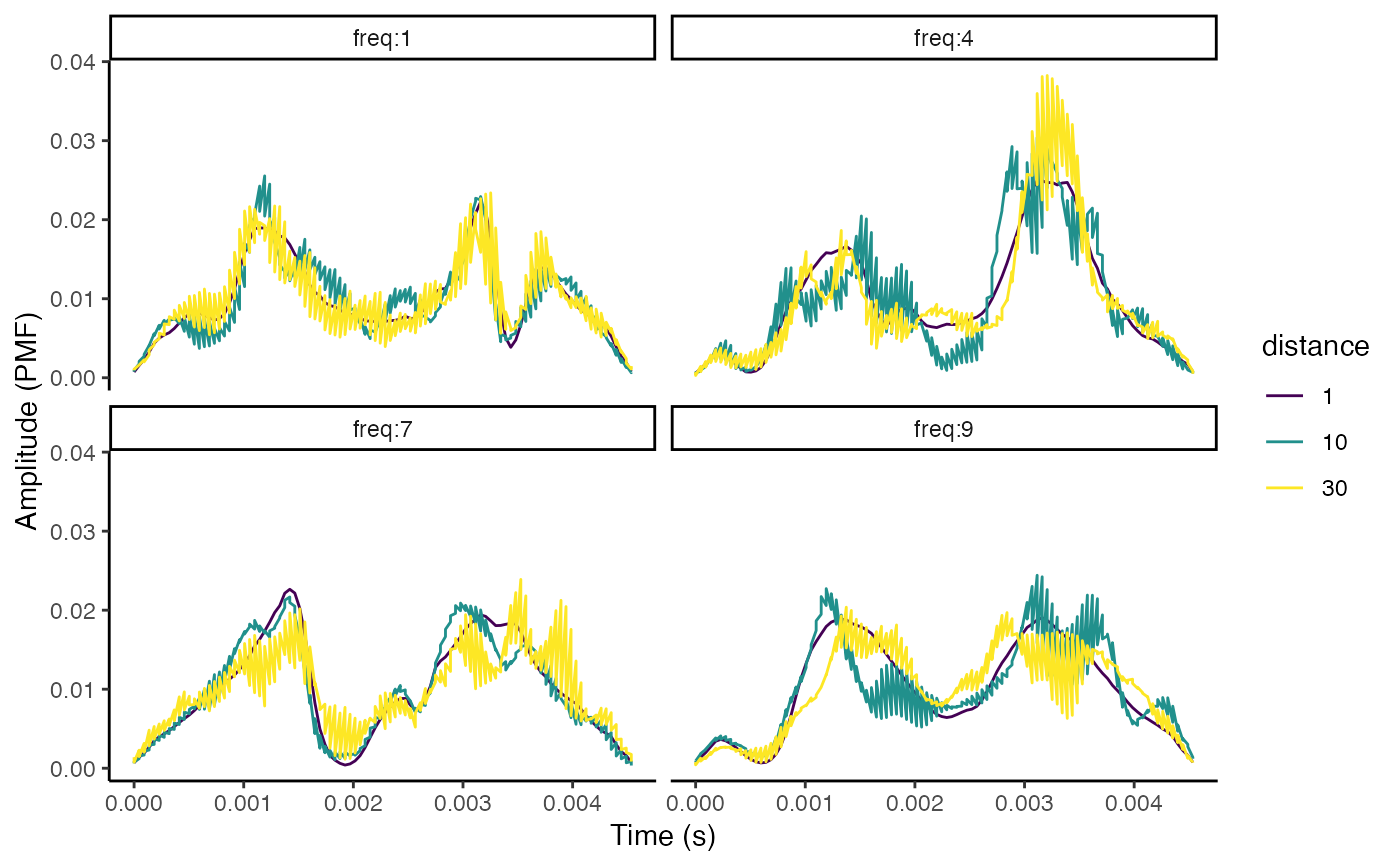
playback has been re-recorded at different distances. Blur ratio is
measured as the mismatch between amplitude envelopes (expressed as
probability mass functions) of the reference sound and the
re-recorded sound. By converting envelopes to probability mass
functions, the effect of energy attenuation is removed, focusing the
analysis on the modification of the envelope shape. The function
compares each sound to the corresponding reference sound within the
supplied frequency range (e.g. bandpass) of the reference sound
(bottom.freq and top.freq columns in X). The sound.id column
must be used to tell the function to only compare sounds belonging to
the same category (e.g. song-types). Two methods for setting the
experimental design are provided. All wave objects in the extended
selection table must have the same sampling rate so the length of
envelopes is comparable.
References
Dabelsteen, T., Larsen, O. N., & Pedersen, S. B. (1993). Habitat-induced degradation of sound signals: Quantifying the effects of communication sounds and bird location on blur ratio, excess attenuation, and signal-to-noise ratio in blackbird song. The Journal of the Acoustical Society of America, 93(4), 2206.
Araya-Salas, M., Grabarczyk, E. E., Quiroz-Oliva, M., Garcia-Rodriguez, A., & Rico-Guevara, A. (2025). Quantifying degradation in animal acoustic signals with the R package baRulho. Methods in Ecology and Evolution, 00, 1-12. https://doi.org/10.1111/2041-210X.14481
See also
envelope_correlation() and spectrum_blur_ratio(), which
measure degradation in the frequency domain.
Other quantify degradation:
detection_distance(),
envelope_correlation(),
plot_blur_ratio(),
plot_degradation(),
set_reference_sounds(),
signal_to_noise_ratio(),
spcc(),
spectrum_blur_ratio(),
spectrum_correlation(),
tail_to_signal_ratio()
Author
Marcelo Araya-Salas (marcelo.araya@ucr.ac.cr)
Examples
{
  # load example data
  data("test_sounds_est")

 # add reference to X
  X <- set_reference_sounds(X = test_sounds_est)
  blur_ratio(X = X)

  # using method 2
X <- set_reference_sounds(X = test_sounds_est, method = 2)
  blur_ratio(X = X)

  # get envelopes
  br <- blur_ratio(X = X, envelopes = TRUE)
  envs <- attributes(br)$envelopes

  # make distance a factor for plotting
  envs$distance <- as.factor(envs$distance)


  # plot
  rlang::check_installed("ggplot2")
  library(ggplot2)

  ggplot(envs, aes(x= time, y = amp, col = distance)) +
  geom_line() + facet_wrap(~ sound.id) +
  scale_color_viridis_d() +
  labs(x = "Time (s)", y = "Amplitude (PMF)") +
  theme_classic()

}